Related Articles
Cortado vs Macchiato at a Glance
If you’ve ever stared at a café menu wondering whether to order a cortado or a macchiato, you’re not alone. Both are small, espresso-based drinks – but they deliver very different experiences in the cup. Here’s a quick side-by-side before we dive into the details.
| Cortado | Macchiato | |
|---|---|---|
| Origin | Spain | Italy |
| Meaning | “Cut” (Spanish: cortar) | “Stained” (Italian: macchiare) |
| Espresso | 1 double shot (~2 oz) | 1 single or double shot (1-2 oz) |
| Milk | ~2 oz steamed milk, little to no foam | Just a teaspoon of milk foam |
| Ratio (espresso : milk) | 1 : 1 | ~4 : 1 or more |
| Serving Size | ~4 oz | ~2-3 oz |
| Texture | Smooth, velvety | Bold espresso with a dot of foam |
| Flavor Intensity | Balanced, mellow | Strong, espresso-forward |
| Best For | Those who want espresso softened by milk | Those who want near-pure espresso with a hint of sweetness |
Now let’s explore each drink in detail so you can decide which one belongs in your daily rotation.
What Is a Cortado?
The cortado was born in Spain’s Basque Country and has become a staple across Latin America and, more recently, specialty coffee shops worldwide. Its name comes from the Spanish verb cortar, meaning “to cut” – the steamed milk literally cuts through the espresso’s acidity and bitterness.
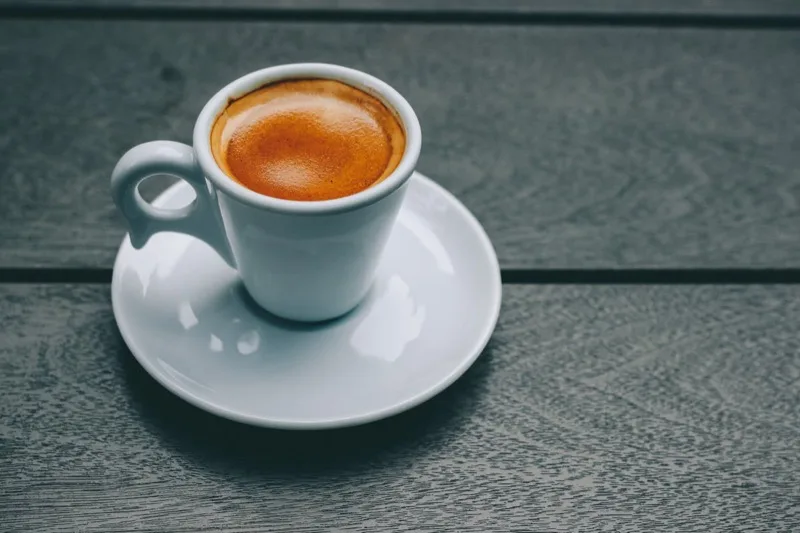
A traditional cortado is beautifully simple: a double shot of espresso paired with an equal amount of warm, lightly steamed milk. That 1:1 ratio is the drink’s signature. Unlike a cappuccino or latte, the cortado has little to no foam – the milk is steamed just enough to warm it and create a silky texture without building a frothy cap.
The result? A small, smooth, perfectly balanced drink. You still taste the complexity of the espresso – its caramel notes, its slight bitterness – but the milk rounds out the rough edges, making every sip approachable and easy to drink.
Key characteristics of a cortado:
- Size: About 4 oz, served in a small glass (often a Gibraltar glass in the U.S.)
- Milk: Steamed, warm, minimal or no foam
- Ratio: 1:1 espresso to milk
- Temperature: Warm, not piping hot – meant to be enjoyed quickly
- Flavor: Balanced and smooth, with the espresso still clearly present
In Spain, you’ll find cortados served at nearly every bar and café, usually alongside a pastry in the mid-morning. It’s an everyday drink – unpretentious, efficient, and satisfying.
What Is a Macchiato?
The macchiato – or more precisely, the caffè macchiato – originated in Italy. The word macchiato means “stained” or “spotted,” and that’s exactly what this drink is: a shot of espresso “stained” with a small dollop of milk foam.

Legend has it that the macchiato was invented so baristas could distinguish between a straight espresso and one with a touch of milk during busy service. The mark of foam on top was a visual signal – this cup had been “stained.”
A traditional macchiato is one of the most espresso-forward drinks you can order. It’s essentially a straight espresso with just a whisper of steamed milk or foam – roughly a teaspoon – placed on top. The milk softens that very first sip but lets the full intensity of the espresso shine through from start to finish.
Key characteristics of a macchiato:
- Size: About 2-3 oz, served in a small espresso cup or demitasse
- Milk: A teaspoon of steamed milk or milk foam on top
- Ratio: Roughly 4:1 or higher (espresso to milk)
- Temperature: Hot, like espresso
- Flavor: Intense, bold, with just a touch of creaminess on top
A word of caution: what many large coffee chains call a “macchiato” – think caramel macchiatos and the like – bears almost no resemblance to the traditional Italian drink. Those are essentially flavored lattes served in reverse. A real macchiato is small, strong, and barely touched by milk.
Key Differences Between a Cortado and a Macchiato
Now that you know each drink on its own, let’s put them head-to-head across the factors that matter most.
1. Milk Ratio
This is the single biggest difference. A cortado uses a 1:1 ratio of espresso to steamed milk. A macchiato uses only a tiny mark of foam – just enough to take the edge off. If milk content were a dial, the macchiato barely touches it; the cortado turns it to the midpoint.
2. Texture
A cortado is smooth and velvety. The steamed milk blends seamlessly into the espresso, creating a uniform, silky body from first sip to last. A macchiato, on the other hand, has distinct layers – a concentrated espresso base topped with a small island of foam. You experience the foam first, then the pure espresso hits.
3. Flavor Intensity
Because it has so much less milk, the macchiato delivers a more intense espresso flavor. The cortado is still espresso-forward compared to lattes or cappuccinos, but the equal portion of milk mellows the acidity and bitterness noticeably.
4. Serving Size
A cortado is typically around 4 ounces. A macchiato is even smaller at 2 to 3 ounces. Both are “short” drinks by modern café standards – neither comes in a 16 oz cup.
5. Origin and Culture
The cortado hails from Spain (and is hugely popular across Latin America), while the macchiato is purely Italian. Both reflect their home cultures’ approach to coffee: small, strong, no-nonsense, and meant to be enjoyed in the moment rather than sipped for an hour.
Taste Comparison: Which One Is Stronger?
Let’s settle this clearly: in terms of caffeine content, a cortado and a macchiato are nearly identical, since both are built on the same foundation – a shot (or double shot) of espresso. Caffeine is determined by the espresso, not the milk.
But perceived strength? That’s where the macchiato wins, hands down. With barely any milk to dilute or soften the espresso, a macchiato tastes noticeably more intense and bitter. You get the full impact of the coffee’s roast character, its crema, its bite.
A cortado, by contrast, tastes balanced. The equal measure of steamed milk reduces perceived bitterness and adds a subtle natural sweetness from the lactose. If you think of espresso strength on a spectrum – with a straight shot on one end and a latte on the other – the macchiato sits much closer to the espresso side, while the cortado lands right in the middle.
Bottom line: Same caffeine. The macchiato tastes stronger. The cortado tastes smoother.
How Each Drink Is Made
Both drinks are simple to make, which is part of their charm. Here’s the step-by-step for each.
How to Make a Cortado
- Pull a double shot of espresso (about 2 oz) into a small glass or cup.
- Steam your milk – aim for warm, silky milk with minimal to no foam. You want it heated to around 150°F (65°C) without building a frothy layer.
- Pour the steamed milk gently into the espresso at a 1:1 ratio. The milk should blend smoothly into the coffee.
- Serve immediately in a 4 oz glass. No latte art needed – though a simple pattern is a nice touch.
How to Make a Macchiato
- Pull a single or double shot of espresso (1-2 oz) into a demitasse cup.
- Steam a small amount of milk – just enough to produce a spoonful of dense, creamy foam.
- Spoon a dollop of foam directly onto the center of the espresso’s crema. Some baristas add a tiny pour of steamed milk beneath the foam.
- Serve immediately. The “stain” of milk on top is the drink’s visual signature.
That’s it. No syrups, no special techniques, no 20-step process. Both drinks celebrate the beauty of high-quality espresso with minimal additions.
When to Choose a Cortado vs a Macchiato
Choosing between these two comes down to what you’re in the mood for – and your tolerance for espresso intensity.
Choose a cortado when:
- You want something smooth that still tastes like real espresso
- You find straight espresso a bit too intense or acidic
- You want a quick, small drink that’s not as filling as a latte
- You’re transitioning from milk-heavy drinks toward more espresso-forward options
- It’s the afternoon and you want a balanced pick-me-up
Choose a macchiato when:
- You love bold, intense espresso and want the full flavor experience
- You’d normally order a straight shot but want just a hint of softness
- You want the smallest possible drink with maximum impact
- You’re an espresso purist who appreciates minimal additions
- You want a quick shot of energy – a macchiato is gone in two or three sips
Neither choice is “better.” They simply serve different moments and moods. Many coffee lovers keep both in their regular rotation.
Cortado vs Macchiato vs Flat White vs Cappuccino
These four drinks all combine espresso and milk, but the ratios, textures, and sizes set them apart. Here’s how they compare:
| Cortado | Macchiato | Flat White | Cappuccino | |
|---|---|---|---|---|
| Size | ~4 oz | ~2-3 oz | ~5-6 oz | ~6 oz |
| Espresso | Double shot | Single or double | Double ristretto | Single or double |
| Milk Type | Steamed, no foam | Dollop of foam | Velvety microfoam | Steamed milk + thick foam |
| Espresso : Milk | 1 : 1 | ~4 : 1 | ~1 : 2 | 1 : 1 : 1 |
| Flavor | Balanced | Very strong | Smooth, creamy | Balanced with airy foam |
| Origin | Spain | Italy | Australia / NZ | Italy |
Think of it as a spectrum. From most espresso-intense to most milk-forward: macchiato → cortado → flat white → cappuccino → latte. Where you land on that spectrum is entirely a matter of personal taste.
How to Order Each One
Ordering these drinks should be simple, but café naming conventions can make it confusing. Here’s how to get exactly what you want.
Ordering a cortado
In most specialty coffee shops, simply asking for a “cortado” will get you the right drink. If you’re at a shop that doesn’t list it on the menu, ask for:
“A double espresso with equal parts steamed milk, no foam, in a small glass.”
In Spanish: “Un cortado, por favor.” – In Spain and Latin America, this is all you need. It’s one of the most commonly ordered drinks at any café.
Ordering a macchiato
At specialty cafés, ask for an “espresso macchiato” to be clear. At chain coffee shops, this distinction matters because “macchiato” alone may get you a large, sweet, latte-style drink.
“An espresso macchiato – just a shot with a dot of foam on top.”
In Italian: “Un caffè macchiato, per favore.” – In Italy, this gets you exactly the right drink. If you want it with warm milk rather than foam, ask for “macchiato caldo.” For cold milk, “macchiato freddo.”
Pro tip: If you’re at a large chain and want the real thing, always say “espresso macchiato” – not just “macchiato.” This signals you want the traditional Italian version, not the caramel-drizzled, 16-ounce interpretation.
Frequently Asked Questions
Is a cortado stronger than a macchiato?
They have roughly the same caffeine since both are espresso-based. However, a macchiato tastes stronger because it has far less milk. The cortado’s 1:1 milk ratio creates a smoother, more balanced flavor.
What does “cortado” mean?
Cortado comes from the Spanish verb cortar, meaning “to cut.” The steamed milk “cuts” through the espresso’s bitterness and acidity.
What does “macchiato” mean?
Macchiato is Italian for “stained” or “spotted.” It refers to the small spot of milk foam placed on top of the espresso.
Can I order a cortado at Starbucks?
It’s not on the official Starbucks menu, but you can approximate one by asking for a double espresso with equal steamed milk and no foam in a short cup. For a traditional macchiato, order an “espresso macchiato” – avoid the Caramel Macchiato, which is essentially a vanilla latte.
Is a cortado the same as a flat white?
No. A flat white is larger (5-6 oz), uses microfoam, and is typically made with a double ristretto shot. A cortado is smaller (4 oz), uses plain steamed milk with no foam, and has a higher espresso-to-milk ratio, making it more espresso-forward.
Which has more milk – a cortado or a macchiato?
The cortado has significantly more milk. Its 1:1 ratio means about 2 oz of steamed milk, while a macchiato uses just a teaspoon of foam.